
GROSS REVENUE IS NOT NET RETURN
This is where rental projections become more useful — and where overly simple ROI claims can become misleading.
A property generating $20,000 in annual bookings does not put $20,000 into the owner’s pocket.
Depending on the property and rental strategy, operating expenses may include:
PROPERTY MANAGEMENT
Professional short-term rental management can represent a significant percentage of gross rental income.
The exact fee depends on what is included:
- Guest communication
- Check-in and check-out
- Pricing management
- Marketing
- Maintenance coordination
- Cleaning management
- Owner reporting
Always compare management companies based on services, not simply percentage.
PLATFORM FEES
Airbnb and other booking platforms charge fees associated with reservations.
Fee structures can change, so projections should use the platform’s current fee model rather than an older estimate.
HOA / CONDO FEES
For condos, monthly association fees can become one of the largest fixed operating expenses.
Depending on the building, those fees may cover:
- Security
- Pool maintenance
- Landscaping
- Common-area electricity
- Backup power
- Water
- Building maintenance
- Administration
A higher HOA is not automatically negative if the building provides amenities that help support stronger nightly rates and occupancy.
INSURANCE
Property insurance should be included in any realistic annual budget, particularly for coastal real estate.
Coverage and premiums vary considerably by property.
PROPERTY TAX — IPI
Qualifying properties may be subject to the Dominican Republic’s annual property tax, or IPI, depending on their assessed value and applicable exemptions.
This is also where CONFOTUR can become especially relevant.
Properties within qualifying CONFOTUR-approved developments may receive an IPI exemption during the applicable incentive period.
That can reduce annual ownership costs and improve the economics of the investment.
FURNISHING, MAINTENANCE & TURNOVER
Rental properties also require ongoing spending on:
- Furniture replacement
- Linens
- Appliances
- Air-conditioning maintenance
- Repairs
- Deep cleaning
- Paint and touch-ups
- General wear and tear
Some cleaning expenses can be passed directly to guests.
Others remain part of ownership.
A good investment analysis is not about finding the highest gross yield. It is about understanding how much of that revenue remains after the property is properly operated.
WHAT COULD A $300,000 RENTAL PROPERTY ACTUALLY PRODUCE?
Let’s use a hypothetical $300,000 condo as an example.
This is not a projection for a specific Cabarete Properties listing. It is simply a model showing how different occupancy assumptions can change the numbers.
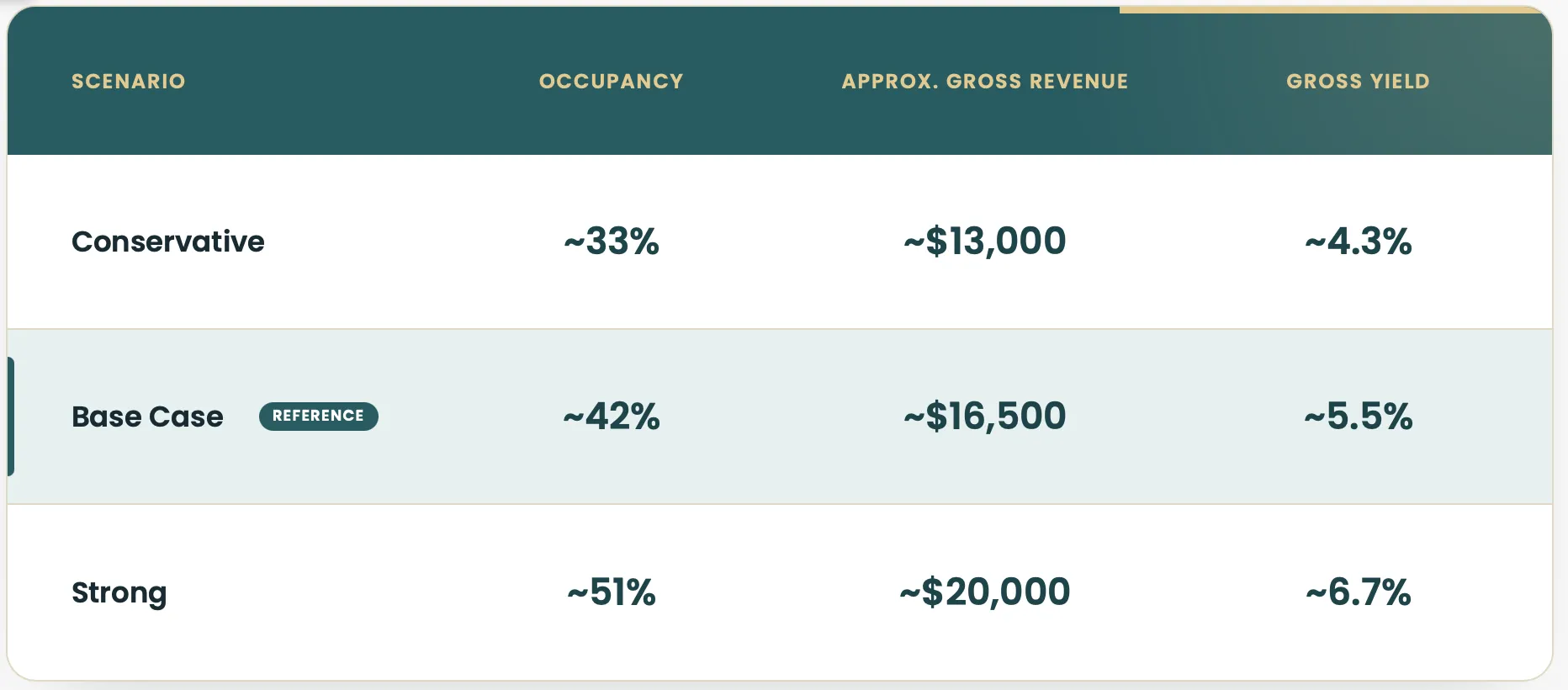
At first glance, gross yields between approximately 4% and 7% look straightforward.
But gross yield is only the first layer.
Before deciding whether a property makes sense as an investment, you need to understand what it costs to operate.
TWO DATA SOURCES, TWO DIFFERENT VIEWS OF CABARETE
Two commonly referenced short-term rental data platforms currently paint noticeably different pictures of the Cabarete market.
Airbtics reports median occupancy around 51%, an average nightly rate of approximately $108, and annual revenue near $20,000.
AirROI, using a different dataset and methodology, reports occupancy closer to 33%, with an average nightly rate around $170 and annual revenue closer to $12,600.
That is a meaningful difference.
One dataset describes a market booked approximately half the year at a lower average rate.
The other suggests fewer occupied nights but considerably higher nightly pricing.
Neither number should automatically be treated as “the Cabarete number.”
WHY CAN THE DATA BE SO DIFFERENT?
Rental analytics platforms may differ in:
- Which properties they classify as active
- How available nights are calculated
- How blocked owner dates are treated
- Property types included
- Geographic boundaries
- Minimum-stay requirements
- The period being analyzed
That is why market-wide data is useful for context — but not enough to underwrite an individual property.
WHAT THIS MEANS FOR AN INVESTOR
When someone gives you an occupancy rate or projected annual revenue, ask:
Where did that number come from?
Then compare it against the actual property.
A professionally managed beachfront 2-bedroom condo with strong photography, reviews, amenities, and walkability should not automatically be modeled the same way as an older unit farther from the beach.
The market average is a starting point.
The property itself is what you are investing in.
HOW TO CALCULATE A MORE USEFUL RENTAL RETURN
Instead of looking only at projected gross revenue, start with four numbers:
- Purchase Price
How much capital are you actually putting into the property?
- Realistic Annual Rental Revenue
Use conservative, base, and strong scenarios rather than one optimistic projection.
- Annual Operating Expenses
Include management, HOA, insurance, taxes, maintenance, platform fees, and other recurring costs.
- Net Operating Income
What remains after operating expenses?
That number gives you a much clearer basis for evaluating the property.
SIMPLE EXAMPLE
Imagine a property produces:
$30,000 in gross annual rental revenue
and annual operating expenses total:
$12,000
That leaves approximately:
$18,000 in net operating income
On a $300,000 cash purchase, that would represent approximately a:
6% net operating yield
The point is not that every Cabarete property will produce 6%.
Some will produce less.
Some may produce considerably more.
The point is that net yield should be calculated from the specific property’s realistic revenue and expenses — not from a market-wide percentage printed on a sales brochure.
THE PROPERTY CAN MATTER MORE THAN THE MARKET AVERAGE
This is especially important in Cabarete.
Two condos with the same purchase price can produce very different rental results.
Why?
Because guests aren’t choosing the market average. They’re choosing a specific property.
LOCATION
A property within walking distance of the beach, restaurants, or watersports may have a different demand profile than one requiring transportation.
BEACHFRONT VS. NON-BEACHFRONT
Direct beach access and ocean views can materially affect both nightly pricing and guest demand.
BEDROOM COUNT
A studio, 1-bedroom, 2-bedroom, and 3-bedroom unit often attract different types of travelers.
AMENITIES
Pools, gyms, security, backup power, parking, beach access, elevators, and common areas can all influence booking decisions.
PRESENTATION
Professional photography, interior design, furnishing, reviews, and listing management can significantly influence performance.
MANAGEMENT
Dynamic pricing, fast guest communication, maintenance, and strong reviews can make a substantial difference over a full year.
That is why a buyer should not ask only:
“What is Cabarete’s occupancy rate?”
A better question is:
“What should this specific property realistically achieve?”
SEASONALITY MATTERS
Cabarete is not a flat twelve-month rental market.
Demand changes throughout the year.
Winter travel brings visitors escaping colder climates in North America and Europe.
Cabarete’s wind season creates another demand cycle around kiteboarding.
Surfing, holidays, school schedules, and international travel patterns also influence bookings.
As a result, the same property may command very different rates throughout the year.
A BETTER WAY TO MODEL RENTAL INCOME
Instead of:
Annual Revenue ÷ 12
Build a month-by-month projection.
For example:
- High season nightly rate
- Shoulder season nightly rate
- Summer / wind-season pricing
- Expected occupancy by month
- Owner-use dates
- Maintenance downtime
That produces a much more useful estimate than assuming every month performs equally.
CONFOTUR CAN CHANGE THE OWNERSHIP MATH
For investors comparing new developments, CONFOTUR deserves special attention.
Qualifying projects can provide exemptions from:
- The 3% property transfer tax
- The applicable annual IPI property tax during the approved exemption period
The transfer-tax exemption reduces acquisition costs.
The IPI exemption can reduce recurring ownership costs.
Both can improve the overall economics of an investment.

THE BOTTOM LINE FOR CABARETE INVESTORS
Cabarete can make sense as a rental investment.
But the answer should never come from one occupancy statistic or one projected ROI percentage.
The better approach is to evaluate three things separately:
Rental Income
What can this specific property realistically generate?
Operating Costs
What will it actually cost to own and operate?
Long-Term Value
Is this a property someone else is likely to want five or ten years from now?
If those three pieces work together, the investment case becomes much stronger.
The goal is not to find the property with the most impressive number on a brochure.
It is to find the property where the real numbers make sense.
EXPLORE CABARETE INVESTMENT PROPERTIES
Looking for a property that can work both as a personal residence and a rental investment?
Explore current opportunities across:
Kite Beach
Watersports-focused condos and beachfront properties
Downtown / Cabarete Bay
Walkable condos with direct access to restaurants, beach life, and town
Playa Encuentro
Newer developments and properties serving the surf and longer-stay market
CONFOTUR Developments
Qualifying new developments with potential tax advantages
FAQ
What is a realistic rental yield for a Cabarete property?
There is no single yield that applies to every property. Gross returns depend on purchase price, occupancy, nightly rates, location, and property type. Net returns also need to account for management, HOA fees, insurance, taxes, platform fees, and maintenance.
Why do Cabarete occupancy estimates vary so much?
Short-term rental analytics platforms use different methodologies, geographic boundaries, and definitions of active inventory. Market-wide occupancy should therefore be treated as a benchmark rather than a guaranteed result for an individual property.
What makes a Cabarete property perform well as a vacation rental?
Location, beach access, amenities, bedroom count, interior design, professional photography, guest reviews, pricing strategy, and property management can all influence performance.
Does CONFOTUR improve rental ROI?
CONFOTUR does not increase rental revenue directly. However, qualifying tax exemptions can reduce acquisition and annual ownership costs, potentially improving the overall return.
Should I buy a property based on projected Airbnb income?
Rental projections should be one part of the decision. Buyers should also consider operating expenses, personal use, resale potential, location, and their expected ownership period.